How many chess puzzles a day actually help
About 15 to 30 minutes a day, so 10 to 20 puzzles solved in your head. What the public data shows, where it falls short, and a week you can copy.
For an adult with a job and a club night, 15 to 30 minutes a day, five or six days a week. At your own level that comes to roughly 10 to 20 puzzles, as long as you solve each one in your head before you touch a piece. Done that way a puzzle near your rating takes a minute or two. Fifty fast guesses fill the same half hour and teach you far less.
Nobody has measured a magic number. FM Nate Solon suggests 10 to 30 minutes a day, and he’d rather see 10 minutes on six days than a one-hour binge once a week. The public data below leans the same way. Regular practice goes with getting better, and piling on more puzzles adds little.
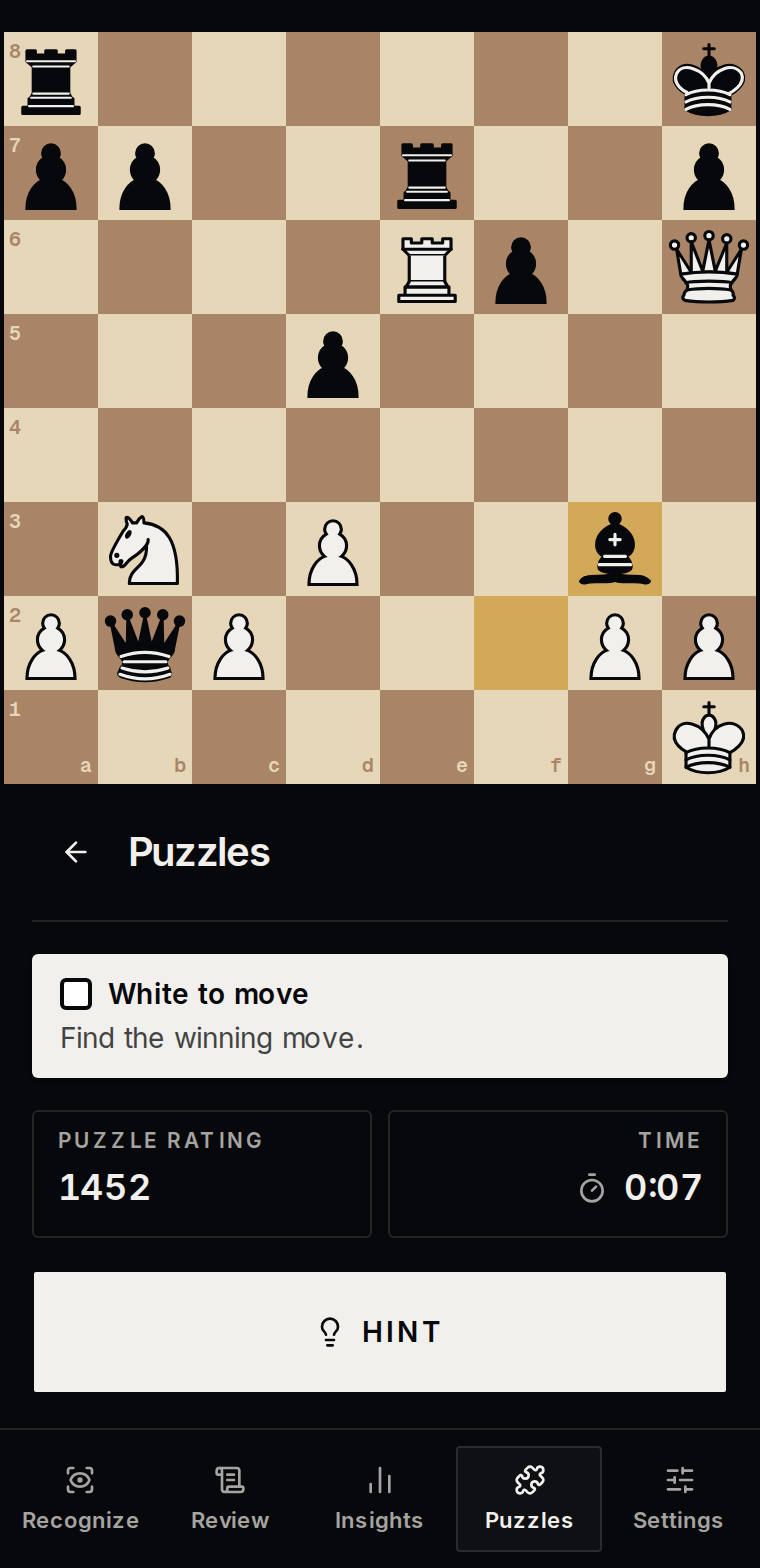
Do puzzles actually improve your rating?
Probably, but nobody has proved it cleanly. These are all the public numbers we could find.
| Source | Sample | What it found | Its limit |
|---|---|---|---|
| Stanford students, published by Chess.com | 96,000 Chess.com users, March to October 2024 | Regular practice went with real rating gains | Doesn’t separate puzzles from games and lessons, and Chess.com, which published it, has a stake in the answer |
| Chess.com study of its members, 2025 | More than 10,000 members over 180 days | Members who do puzzles improved 2.5 times faster | The baseline and method behind that figure aren’t published, and Chess.com itself writes that correlation is not causation |
| Chess.com survey | 33,131 members | After playing, puzzles are the most used way to train | Tells you what people do, says nothing about what works |
| 14-day Puzzle Rush and Storm challenge, Say Chess | 89 players, 50 of them lasted all 14 days, 150,244 puzzles | Players with more than 100 runs improved less than the rest | Small, self-selected, two weeks, and it measured run scores rather than game rating |
| Woodpecker analysis, Disco Chess | 431,899 attempts by 1,952 users | +35 Elo on average for the 105 users with enough rated games | No control group, and it was written by an app built on the method |
None of these isolates puzzles. People who do puzzles every day also play more and study more, so part of the gain is just them being keen. The one thing every source agrees on is that showing up often matters more than a big session.
Why am I doing puzzles every day and not improving?
Usually because you’re guessing. You see a move that looks right, play it, and let the board tell you if it was. That trains you to move on a hunch, which is exactly what loses your rapid games.
Before you move, say the line to yourself. Your move, their best reply, your answer. If you can’t name their best reply, you haven’t solved it yet. How to solve chess puzzles goes through the method on a real puzzle.
The other reason is that the habit stays on the puzzle page. In a game nobody tells you there’s a tactic, and why your puzzle rating is higher than your game rating is about closing exactly that gap.
Is Puzzle Rush good for improvement?
It depends on what you play.
| Feature | Puzzle Rush or Storm | Rated puzzles |
|---|---|---|
| What it trains | Spotting simple patterns fast | Calculating a line to the end |
| Clock | Everything | Shown, but it shouldn’t matter |
| Difficulty | Starts easy, gets harder as the run goes on | Around your rating |
| Best for | Blitz and bullet players, a warm-up | Rapid and classical players |
If you mostly play blitz, Solon’s advice is to do a lot of Rush. If you play rapid, keep Rush as a warm-up and do the real work on rated puzzles. In the 14-day challenge, the people grinding the most runs gained the least.
Should you repeat the same puzzles?
The Woodpecker method says yes. You solve a fixed set, then the same set again in less time, cycle after cycle, until the patterns come without thinking. The Disco Chess numbers above, caveats included, are the best public data on it.
Chesslord’s rated puzzles do the opposite. You never get the same puzzle twice, solved or failed, so every one is a position you haven’t seen, which suits a short daily session. If you want to drill a set as well, keep a puzzle book or a Woodpecker set alongside.
How hard should your puzzles be?
Hard enough that you need to calculate, easy enough that you solve most of them. If you’re getting nearly every one right in seconds, they’re too easy. If you fail most of them, you’re guessing.
On Chesslord your puzzle rating starts from your game rating, so the first puzzle is already near your level. After that the next puzzle is aimed at your rating and climbs by 25 for each one you solve in a row, up to +200 above it. Miss one and it drops back. So after five solved in a row, the sixth is aimed about 125 points above you, which is where calculating stops being optional.
When should you stop for the day?
Stop when you catch yourself moving before you can say the line. Two or three misses in a row where you just tried something are tilt, and every puzzle after that trains the wrong habit. Asking for a hint counts as a fail on Chesslord, so a run of hints is the same signal.
Also stop at the time you set. If you planned 20 minutes and you’re still going after 40, the last 20 were probably guesses.
What does a good puzzle week look like?
A week for a club player who gets a few rapid games in. Swap the days around to fit your life.
| Day | Puzzles | Games | Review |
|---|---|---|---|
| Monday | 20 minutes rated | None | None |
| Tuesday | 15 minutes rated | One rapid game, 15+10 | 10 minutes on that game |
| Wednesday | 20 minutes rated | None | None |
| Thursday | 15 minutes rated | One rapid game, 15+10 | 10 minutes on that game |
| Friday | 10 minutes of Rush, for fun | Blitz if you like | None |
| Saturday | 15 minutes rated | Two rapid games | The loss, or both |
| Sunday | Rest | None | Read back through the week’s notes |
That is 85 minutes of rated puzzles over five days. The review column is where puzzles start paying off in games, and how to analyze your chess games shows a ten-minute routine for it.
How Chesslord helps
Solve puzzles