How much opening theory do you really need?
Even Carlsen leaves the named lines around move 4. How deep your theory has to go, why memorising more pays off less, and how to find your exit move.
Opening books run to hundreds of pages, and a club player who opens one usually ends up asking how much of it they actually need. Look at where real games leave theory and the answer is less than the books suggest. What matters more is knowing where you leave it and what to do next.
How many moves of theory do you need?
Only as many as your games actually stay in theory, and that’s fewer moves than most people guess. In Chesslord a move counts as book while the game is still in the well-known opening lines, the ones with a name, and the game leaves theory on the first move that isn’t. Real theory goes deeper than the named lines, so this is the point where you leave the familiar ground. Your own preparation can run further than that.
In Chesslord’s demo insights, 375 of Magnus Carlsen’s chess.com games from May to August 2026, both players leave the named lines early.
| Carlsen with | Games | Carlsen left theory first | His opponent left first | Average move where Carlsen left |
|---|---|---|---|---|
| White | 191 | 90 | 101 | around 4 |
| Black | 184 | 80 | 104 | around 4 |
These are mostly blitz games, where strong players often pick less-analysed lines to get a fresh position. Carlsen has said that in classical chess you can memorise 20 moves and still struggle to get a game, which is why he likes Freestyle chess. Still, in a game between two of the best-prepared players online, the game usually left the named lines within the first five or six moves.
Club games look similar. A 2023 count of 207 games from one Lichess classical arena found players reached a position they had never had before, in their own games, at about move 5.7 on average. It’s a small sample from a single event, but it points the same way.
Why does memorising more pay off less?
Every extra move of theory multiplies the lines. Say your opponent has three sensible replies at each turn. Five of their moves deep, that’s 243 lines to know. Ten moves deep, it’s 59,049. You can’t learn that, and you don’t need to, because most opponents leave the main line long before you would have used it.
So the first moves of each line are the most valuable. Moves 1 to 5 come up in every game you play with that opening. Move 15 of one sharp line might come up once a year.
What should you learn instead of more moves?
- The moves up to where your opponents usually leave the line, for each opening you play, and for each colour
- The two or three most common ways people leave it, and how to punish them
- The plans that go with the pawn structure, because they still apply after a move nobody has seen before
- The traps in your own openings, both the ones you can fall into and the ones you can set
An observational study of more than 1,250 players published in a student journal in 2026 found that players who used fewer different openings tended to gain rating faster. It’s weak evidence, and it doesn’t show cause. It does fit the arithmetic above, since a small repertoire lets you go deeper in the lines you actually meet.
Why the move after theory matters most
Look at the board at the top. Carlsen used under 9 seconds for his first six moves, then spent 16 seconds on 7...d5, right where the game left theory. Copy that habit. When your memory runs out, slow down and give the position a real think.
Most club players do the opposite. They play the moves they know quickly and keep the same tempo once those run out. The first move out of theory is often a game’s first real decision, and it’s worth more of your clock than the ten moves before it.
How to find where you leave theory
Chesslord’s insights have a mastery panel for each colour. For every opening you play it shows how many games you’ve played, in what share of them you were the one to leave theory, and the average move where you did. A chart shows whether that move is getting later over the weeks.
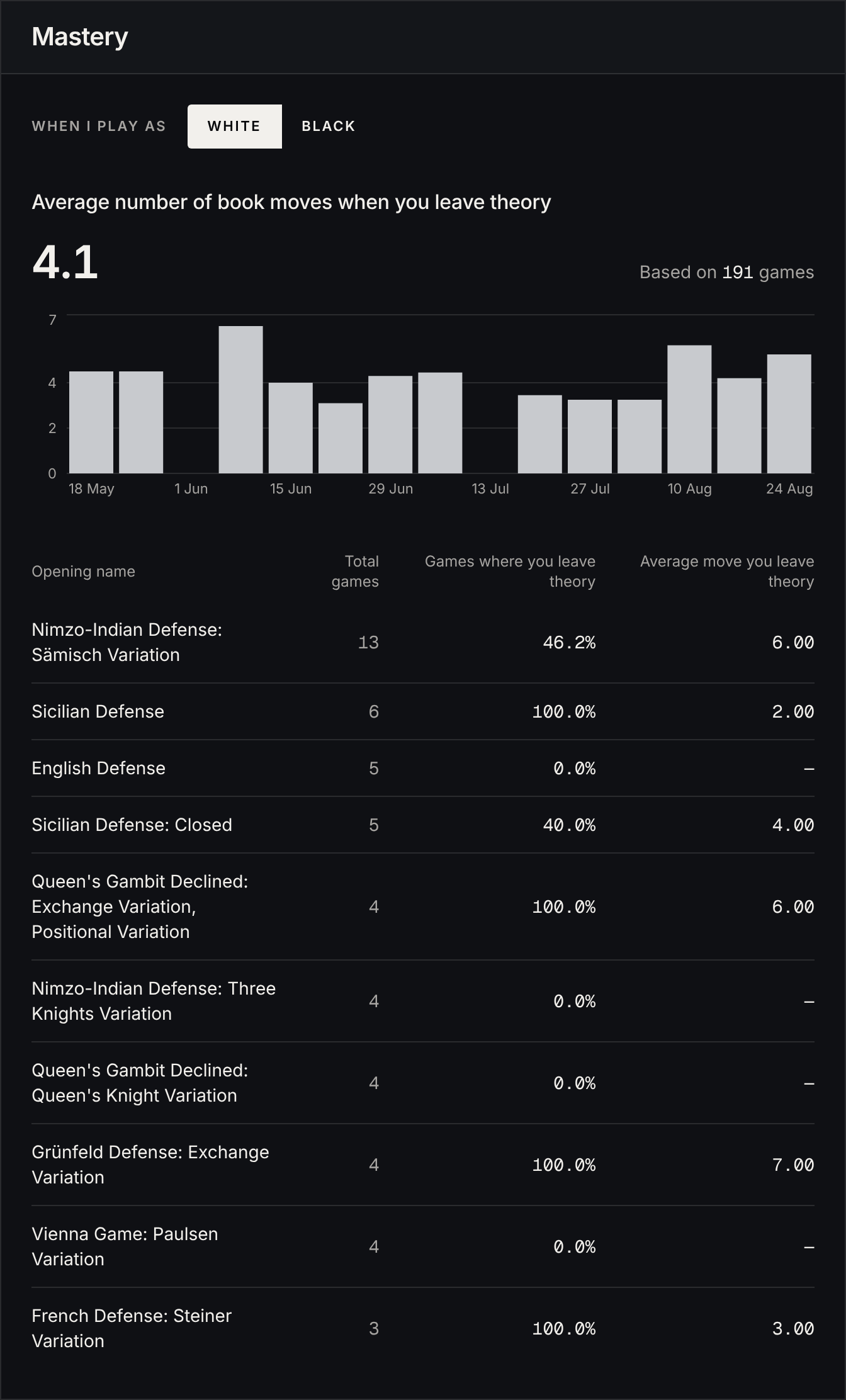
Read it like this.
- You leave first, early and often in one opening, and that opening also has poor results in the openings panel. Learn two or three more moves there.
- Your opponents leave first. More memorising won’t help there. Open those games in the game review and learn how to punish the moves they play.
- Your exit move is getting later. Your study is reaching your games.
The game review marks every book move, so you can see the exact move where each game left theory.
If you’re still choosing a repertoire, start with the best chess openings for beginners or the pages for 1000, 1200 and 1500. What is a book move in chess explains the book label you’ll see in reviews.
How Chesslord helps
Stats from your games