How to beat a higher-rated chess player, and how often you will
What the rating formula expects against a stronger opponent, where upsets come from in real games, and how to give yourself more of them.
A rating gap feels like a wall. Against someone 200 points stronger most players expect to lose, and they often play as if they already have. The formula is less gloomy than that, and in fast chess, even against the world number one, the biggest underdogs can do better than it predicts.
What does a rating gap mean in expected score?
Elo turns a rating difference into an expected score, the share of points the stronger player should take over many games. Chess.com and Lichess use Glicko, a refinement of the same idea, so the numbers below are close for both.
| Rating gap | Stronger player’s expected score | Weaker player’s expected score |
|---|---|---|
| 100 | 64% | 36% |
| 200 | 76% | 24% |
| 300 | 85% | 15% |
| 400 | 92% | 8% |
Expected score isn’t the chance of winning, because a draw counts as half a point. Against someone 200 points stronger, 24% might be a win and three draws in ten games. That’s far from hopeless, and it’s the rate at which you take points off them when you play normally.
How often do upsets happen in real games?
Chesslord’s demo insights hold 375 of Magnus Carlsen’s chess.com games from May to August 2026. Taking 3335, his rating in the game at the top of this page, here is how he did against each band of opponents.
| Opponents rated | Games | Carlsen’s score | Formula expects about |
|---|---|---|---|
| 2700 to 2999 | 93 | 84% | 93% |
| 3000 to 3099 | 100 | 81% | 84% |
| 3100 to 3199 | 67 | 78% | 74% |
| 3200 to 3299 | 63 | 60% | 62% |
| 3300 to 3399 | 24 | 46% | 48% |
The bands hold 347 of the 375 games, and the first row joins three 100-point bands. Against players near his level the formula is close. Against players roughly 350 to 650 points below him, the underdogs did better than it predicts. They won 8 of those 93 games and drew 13. It’s one player, mostly in blitz, and his rating moved during those months, so the gap should be read loosely. Fast chess tends to look like this. The clock and the odd blunder pull results towards the middle, and even the best player in the world drops points he shouldn’t.
Where do upsets come from?
In fast chess, often not from a brilliant attack. Look at the game at the top. Carlsen made a mistake on move 16, his opponent missed the punishment, and the game went on for 34 more moves before White won the endgame. There was no knockout blow. White kept the position playable and was still there when the stronger player went wrong.
Carlsen’s numbers point the same way. He scored 83% in games under 40 moves and 64% in games over 60. Games often run long because they’re balanced, so this doesn’t mean long games beat strong players. It does mean the ones that stay level stay dangerous for the favourite.
How do you beat a stronger player?
- Play your normal game, and skip the cheap trap you’ve been hoping they fall for, because stronger players rarely walk into them
- Keep the position playable rather than trading into a quiet ending at the first chance, unless the ending is one you know
- Don’t fall behind on the clock early, so you have time to punish the mistake when it comes
- After a move that surprises you, check every capture before you reply. White missed 17.Rxe6 right after Carlsen’s 16...Be6
- Don’t resign a position you can still defend, because every extra move is another chance for the favourite to slip, as Carlsen’s long games show
Does playing stronger opponents make you improve faster? There isn’t much evidence either way. An observational study of more than 1,250 players in a student journal found the opposite of what people expect, as more games against higher-rated opponents went with slower rating gain. That’s a correlation from one dataset, and it doesn’t show that stronger opponents hold you back.
How to see your own results by opponent rating
Chesslord’s insights show your results against each band of opponent ratings, with the number of games in each band. Filter by time class, because the same gap plays very differently in bullet and in rapid.
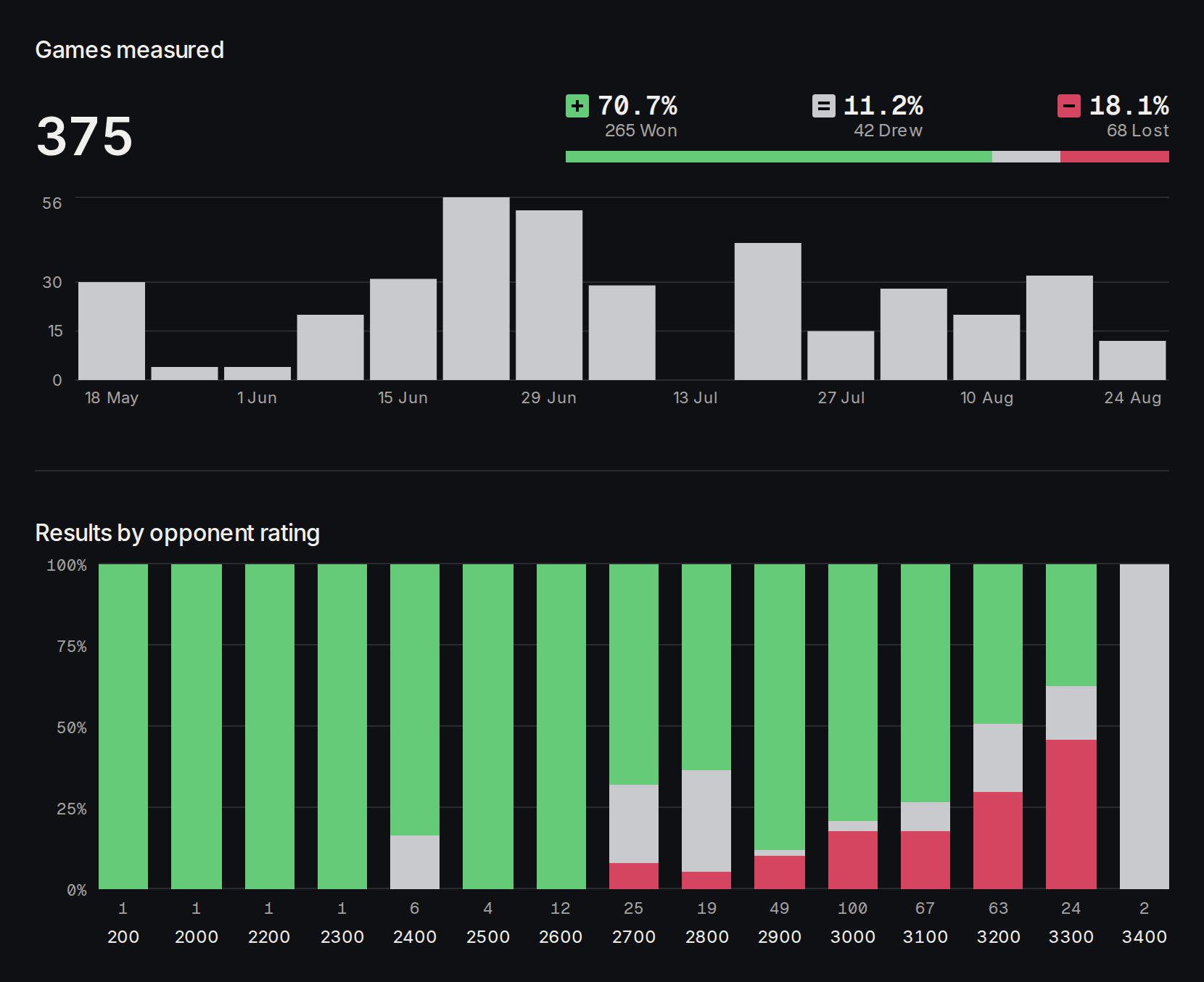
If you score close to the formula against stronger players, your rating is about right and the next step is improving your play. If you score well above it, more than fast chess alone explains, you may play better against strong opponents than against weak ones, so check your losses to lower-rated players in the game review. How to analyze your chess games covers how to go through them.
How Chesslord helps
Stats from your games