What is a good accuracy in chess?
No accuracy score is good everywhere, because each site measures it differently. What moves the score, why one quiet move can cost more than a lost piece.
You finish a game, open the review and see 74. Is that good? It depends on the site, the game and your opponent more than on your level. Once you know what pushes the number up and down, it becomes a useful number.
What does accuracy measure?
How much winning chance your moves gave away compared with the engine’s best, put on a 0 to 100 scale. Chess.com calls its version CAPS2 and doesn’t publish the formula. It says most scores fall between 50 and 95. Lichess publishes its own. It turns each evaluation into a winning chance, scores every move by how much winning chance it gave away, then combines the moves in a way that weighs the bad ones more than a plain average would.
Chesslord shows an accuracy for both players in every game review, on a scale of its own, worked out from Stockfish’s evaluations. The scales differ, so a 74 on one site and a 74 on another don’t mean the same thing.
Why can a quiet move cost more than losing material?
Because accuracy follows winning chances, and material only counts when it changes them. Take the published Lichess formula as an example.
| The move | Evaluation before and after | Winning chance before and after | That move’s accuracy |
|---|---|---|---|
| A slip in an equal position | 0.0 to −1.0 | 50% to 41% | about 67 |
| Giving back four pawns of advantage when you were crushing | +9.0 to +5.0 | 97% to 86% | about 64 |
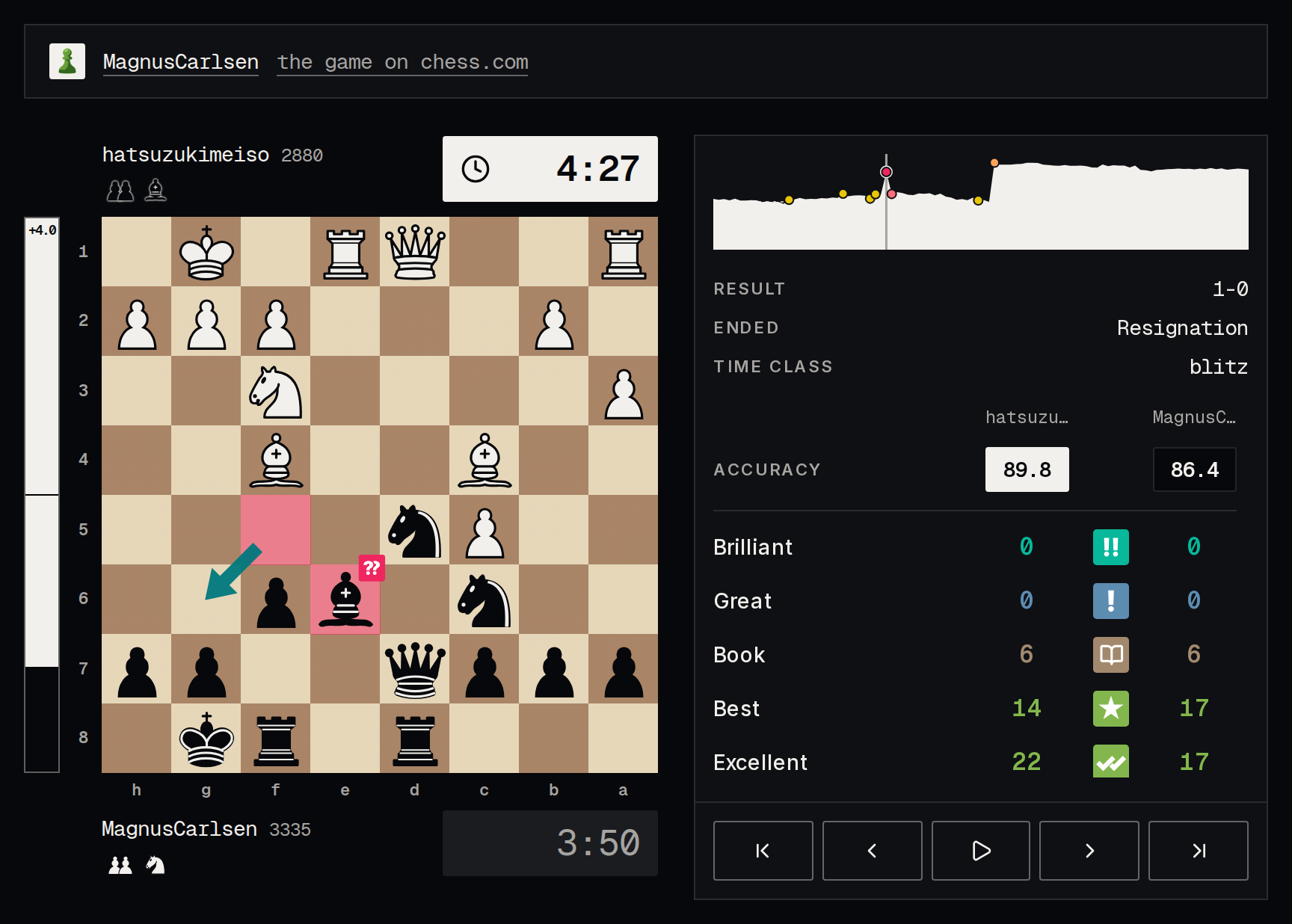
| 1.Ke3?? in the ending at the top | +5.9 to 0.0 | 90% to 50% | about 16 |
A one-pawn slip from equality costs about as much as dropping four pawns of advantage when the game was already won. And a king move that loses nothing on the board, like the one at the top, can be the worst move of your game.
This explains most of the surprises people post about.
- Short games and one-sided games score high, because once you’re far ahead your moves barely change your winning chances
- Long, balanced games score lower, because every inaccuracy happens in the zone where winning chances move most
- Your accuracy depends on your opponent. If they collapse early, you get the easy moves
- The loser can have the higher accuracy. One blunder in a level position decides the game but is only one move in the average
So what is a good accuracy?
A good accuracy is one above your own average, on the same site and in the same time class. There isn’t a number that works for everyone. Players on forums have tried to fit accuracy to rating and found it creeping up by roughly one to two points per 100 rating points. Those are self-selected games, though, and single games swing a long way around any average.
Swap the usual questions for these.
| Instead of | Ask |
|---|---|
| Is 74 good? | Is 74 good for me, on this site, in this time class? |
| Why did I score 68 in a win? | Where did my accuracy drop, and was it before or after I was winning? |
| My opponent had 85, I had 80 | Which single move made the difference? |
The game at the top of what is a blunder in chess shows how one move can do most of the damage. What does the evaluation mean in chess explains the numbers the accuracy is built from.
How to use your accuracy
Compare it with yourself, on one site and one time class, over many games. Chesslord’s insights show your average accuracy, split into the games you won, drew and lost, and laid out by move number, by game phase, by piece, by time of day and by day of the week.
- A big gap between your wins and your losses is normal. A small one means you lose games you play reasonably, often on the clock or to one blunder
- Accuracy that drops at a certain move number tells you where to study. A drop early in the game is often where your opening knowledge ends, a drop after move 30 is often the endgame or the clock
- A low accuracy with one piece, often the queen or the king, points to positions you misjudge
When your accuracy keeps rising over months in the same time class, your play is getting better, whatever your rating did that week.
How Chesslord helps
Move-by-move game review