When should you castle in chess?
Castle early is a rule of thumb for two jobs, a safe king and a rook in play. When to castle at once, when to wait, and when not to castle at all.
Every beginner learns to castle early, and most club players do it on autopilot. The rule is right most of the time. It also has exceptions, and to spot them it helps to know what castling is for.
Why do you castle?
Castling does two jobs in one move. It takes the king off the centre files, which open first in most games, and it brings a rook from the corner towards the middle, where it can fight for the open files. Castle early is a shortcut for getting both done before the centre opens.
So the useful question is whether your king is safe where it stands and whether your rooks can get into the game. When castling is the fastest way to both, castle. When it isn’t, you can wait.
When should you castle at once?
- When the centre is opening or about to, because pawns are being exchanged on d4, d5, e4 or e5
- When an enemy rook or queen can reach the file your king stands on
- When you’ve brought out the pieces between the king and the rook and have nothing more urgent to do
- When castling is also your best developing move, as in the Berlin at the top, where White castles instead of defending e4, because if Black takes, the e-file opens against Black’s uncastled king
When should you wait?
When the centre is closed and nothing can reach your king soon, castling can wait a few moves. Waiting can even help. Your opponent doesn’t know which wing you’ll go to, so they can’t start a pawn storm on it yet. That’s why in closed openings strong players often castle late, after the opponent has committed.
You should also wait, or pick the other side, when the wing you were going to castle on is already under fire. Pawns you’ve pushed in front of it, an enemy bishop on the long diagonal or a knight heading for g5 all mean castling there would put your king into the attack.
When shouldn’t you castle at all?
When the queens are off and the game heads for an endgame. Without queens the king is rarely a target and becomes a strong piece, and it belongs in the centre, close to the pawns. In those positions castling wastes a move.
Outside those endgames, not castling is usually a mistake, as in the example below. Very few games go the whole way without anybody castling. One forum count of ChessBase’s Mega 2015 found that neither side castled in 3.8% of games between players rated 2200 and above.
The king that never castled
What does the data say about castling?
Less than the rule suggests. There’s no good public study linking when people castle to how often they win, and forum attempts find small effects that the rating gap between the players swamps.
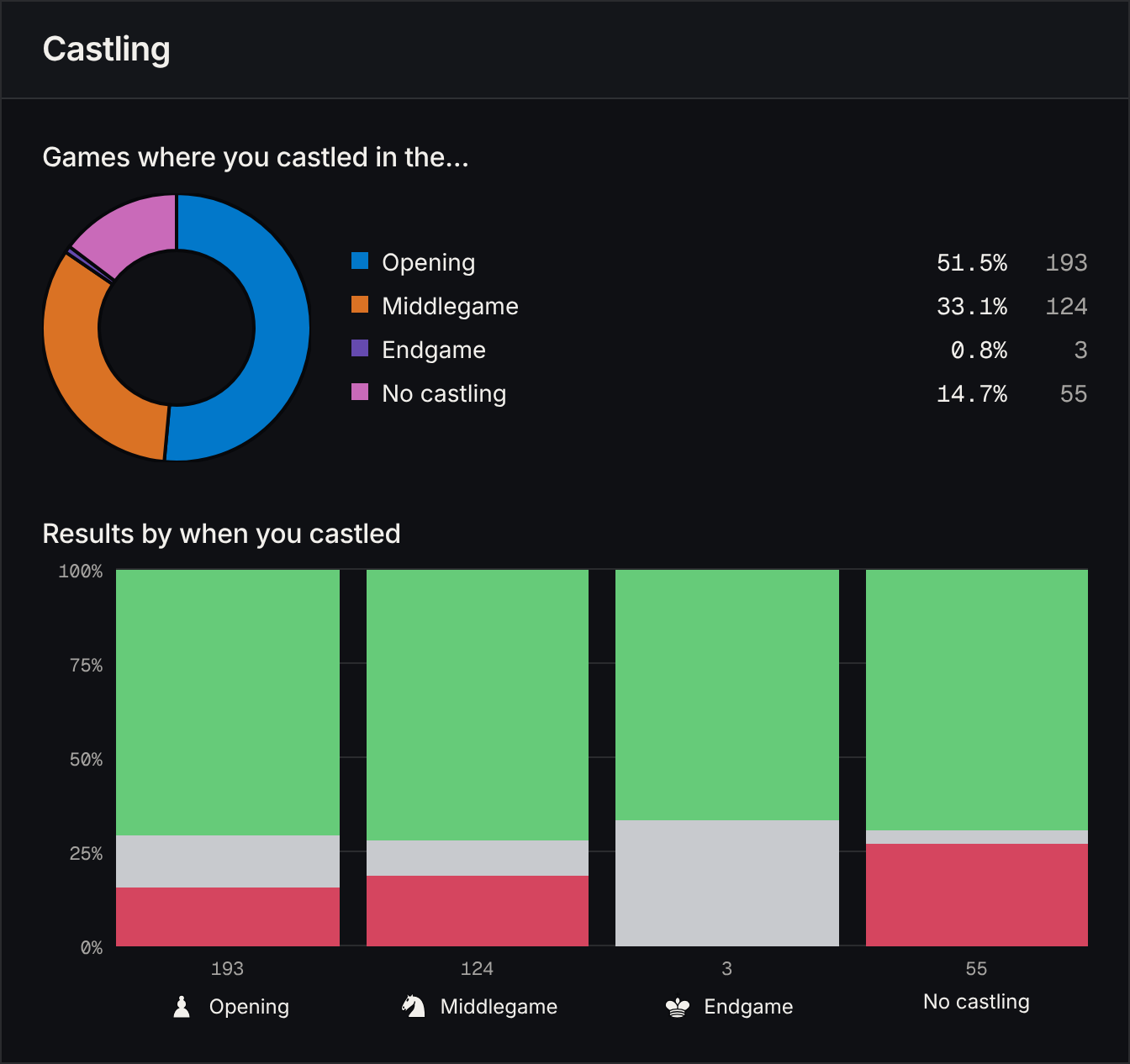
Chesslord’s demo insights count it for Magnus Carlsen’s 375 chess.com games from May to August 2026.
First, what the phases mean. In Chesslord the opening ends once enough pieces have been traded or developed. So if you bring out both knights, both bishops and the queen before you castle, you castled in the middlegame. The endgame starts when only a few pieces are left.
| Carlsen castled | Games | Share | Score |
|---|---|---|---|
| In the opening | 193 | 51% | 78% |
| In the middlegame | 124 | 33% | 77% |
| In the endgame | 3 | 1% | 83% |
| Never | 55 | 15% | 71% |
The world number one castles after the opening in a third of his games, with almost the same score as when he castles early, and doesn’t castle at all in about one in seven. That 15% is him alone, so it isn’t comparable with the 3.8% where neither side castled. The never column is lower, but 55 games leave a margin of around 12 points either way. It also mixes games where the queens came off early, where not castling was right, with games where his king got stuck.
How to check your own castling
Chesslord’s insights have a castling panel. Look at two things.
- How big your never castled share is, and how you score in it. If it’s large and your score is low, open those games in the game review and check whether the king got caught in the centre or whether the queens came off early
- Whether castling in the middlegame scores clearly worse than castling in the opening, over a few hundred games. If it does, you’re probably leaving the king in the centre one or two moves too long
The game review shows the move where each of those games turned.
The tactics that punish a king left in the middle are mostly forks, pins along the e-file and checks that win a tempo. A king that has castled has its own weak spot, covered in what is a back rank mate.
How Chesslord helps
Stats from your games